About
«The Zurich Archipelago – Recreating Common Grounds»
Curated by MirjamVaradinis
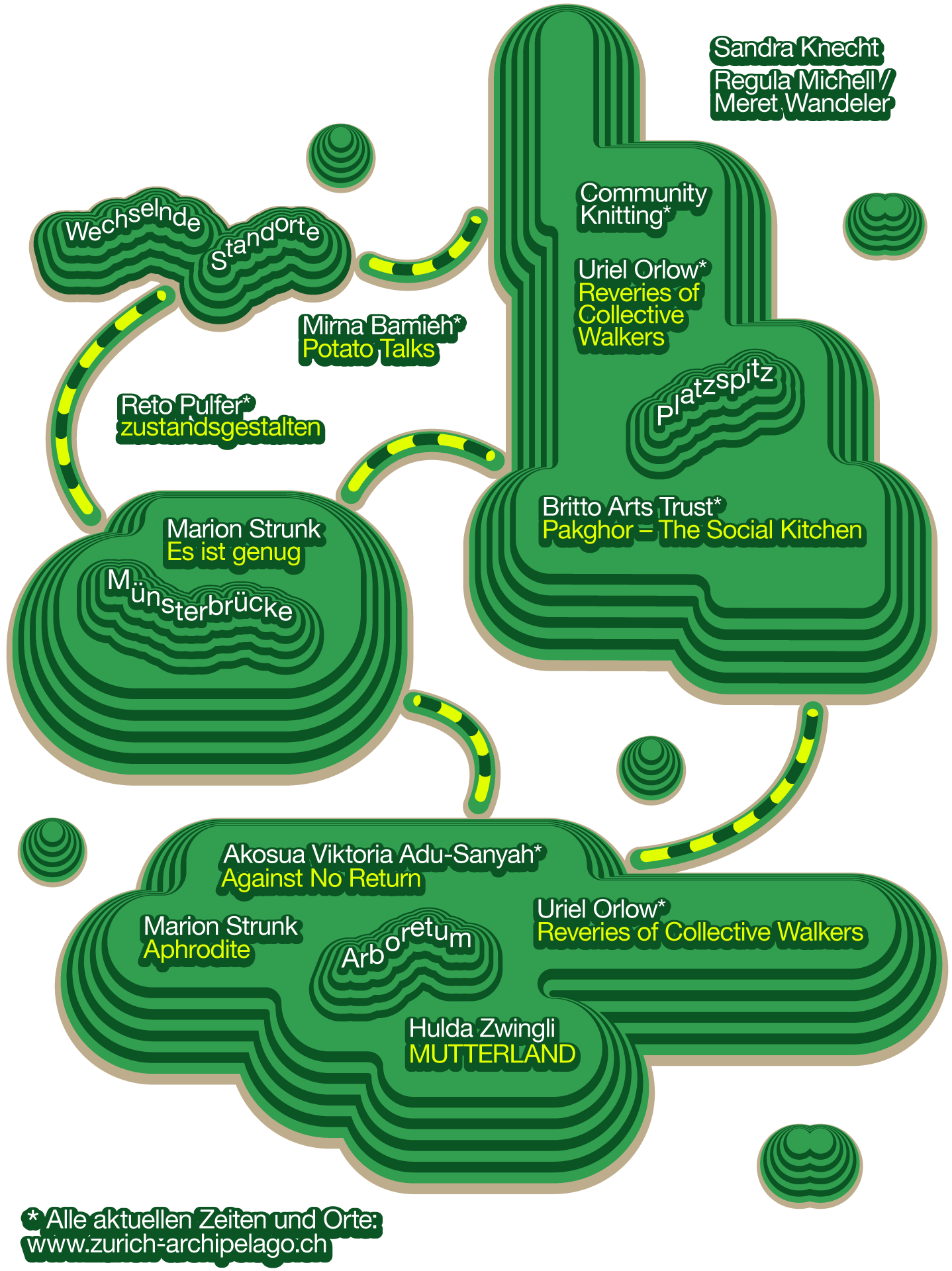
We live in a time of rising tensions and deepening social divisions. Populist movements and identitarian ideologies are gaining influence in many countries, leading to exclusion and conflict. How can spaces be created that offer the opportunity to recognize or rediscover common ground? Art has the potential to bring different people together. The Zurich Archipelago – Recreating Common Grounds explores this idea by inviting audiences to actively engage with the artworks and become part of a collaborative process. The performative art festival in public space is held from June 6 to July 12 across multiple sites throughout the city as an archipelago of artistic “islands”.
A key source of inspiration for the curatorial concept of The Zurich Archipelago was the Caribbean poet, thinker and philosopher Édouard Glissant (1928–2011). In his writings, the archipelago is a central image and far more than a geographical group of islands. It is a metaphorical figure that he contrasts with the idea of the “continent”. For Glissant, the continent stands for unity, centralism and closure, as embodied by Western European thought, colonialism and nationalism. The “archipelago”, on the other hand, symbolizes multiplicity, openness and movement. The islands of an archipelago remain distinct yet connected. They exist in relation to one another without merging into a fixed whole – a principle reflected in the decentralized structure of the art festival.
The concept of movement and exchange is reflected in the performative and process-based formats of The Zurich Archipelago, which are often created collectively and directly involve the audience. The works come and go – much like the waves that lap around the islands of an archipelago.
The artistic contributions are dispersed across various “islands” in the urban space, with several works converging at two locations: the Platzspitz Park behind the Swiss National Museum and the Arboretum near Bürkliplatz by the lake.
Platzspitz is one of the oldest and most historic green spaces in Zurich. For over 450 years, the park – conceived as an island – has existed between the two rivers, the Limmat and the Sihl. Over the centuries, the site has undergone a rich and eventful history: from its beginnings in the late Baroque era through the construction of the main train station and the opening of the first National Exhibition with the Swiss National Museum in the 19th century, all the way to the 1980s, when the grounds acquired a notorious reputation as “Needle Park”. Today, the park serves as a meeting place for diverse communities.
The Arboretum was originally planned as a traditional park but later evolved into a remarkable botanical collection thanks to the dedicated efforts of renowned experts. Seeking to combine beauty and science, they arranged the trees according to geographic, taxonomic and historical criteria to create an arboretum – a botanical garden devoted to trees. While the abundant variety of trees evokes Glissant’s idea of diversity, the site also offers an opportunity to critically question Western academic thinking and to create space for alternative ways of relating to nature.
With works by Britto Arts Trust, Akosua Viktoria Adu-Sanyah, Mirna Bamieh, Sandra Knecht, Regal Michell / Meret Wandeler, Uriel Orlow, Reto Pulfer, Marion Strunk and Hulda Zwingli.
Organisation
«The Zurich Archipelago – Recreating Common Grounds» is a project by the City of Zurich, Art in Public Space (KiöR), curated by Mirjam Varadinis.
Awareness
Welcome to the Archipelago
The art festival «The Zurich Archipelago – Recreating Common Grounds» wants to create spaces of encounter – through cooking, eating, knitting, listening or performing together. To keep this space open and enriching for everyone, we share a few principles.
How we treat each other
We meet with openness and respect – regardless of background, gender, physical ability, language or way of life. Discrimination, verbal and physical violence have no place here.
No means no. In conversation, at the table, when joining in. Nobody has to do anything they don't want to.
The artworks, installations and performances deserve care and respect – even when they invite you to participate.
When you join in: participation in performances and shared activities is based on mutual awareness. Interactions and physical contact only happen when welcomed by everyone involved.
If something feels wrong
Our team is here for you – look for the blue T-shirts with «The Zurich Archipelago». Please approach us if you feel uncomfortable or witness something that doesn't feel right.
Special Thanks
Communities
Alba Chantico Ledesma, Maria del Mar, Maria Victoria, Pepa & Milovan, Cipriana und Jenny Stutz von Expotranskultur
Eirini Sourgiadaki, Daniel, Hiba Tahhan und das ganze Team von Mosaik
Silvana Lindt von Cuisine sans Frontières und ihren Köch*innen Dave Wälti und Anjum Amirtham
Sandra Knecht
Rebecca Clopath
Patrick Hari, hari.studio
Chaja Lang
Ana, Anas Finger Food
Andreas Hug, stir it up, Schweizerisches Rotes Kreuz
Nevin Hammad, Marwan El-Chami und Freunde, Freiwillige youngCaritas
Sarah Reyes, coincoin.zurich, Studio Chou Chou
Achoo Kollektiv
Stephanie Heid & Patrick Wirz (Halo-Halo CH)
Handarbeitstreff Alter- und Pflegezentrum Grünhalde
Eva Torp und Petra Gibler vom Interkulturelles Kreativ Studio, Projekt von Solinetz und Reformierte Kirche Bullingerhaus
Die Bewohner*innen des Gesundheitzentrums Trotte
Stricktreff GZ Loogarten
Die strickenden Bewohner*innen des Alters- und Pflegezentrum Herrenbergli
Sabrina Schumacher Unterstützung beim ganzen Textilen und Durchführung der gemeinsamen Stricken und Häkelns
Artists
Britto Arts Trust, Akosua Viktoria Adu-Sanyah, Mirna Bamieh, Sandra Knecht, Regal Michell / Meret Wandeler, Uriel Orlow, Reto Pulfer, Marion Strunk und Hulda Zwingli
Performers
Ewelina Guzik-Zubler
Yana Brunner
Fabio Feo
Tanja Boinay
Sabrina Stutz
Anna Hofmann
Mayar El Bakry
Moritz Brill
Alexander Nüesch
Julia Genesis Gottet